Having a beautiful kitchen is one of the greatest perks of being a homeowner. There’s nothing like cooking, entertaining, and bonding with friends and family in the kitchen of your dreams.
But when the paint on the cabinets start wearing out, the whole kitchen immediately goes from tasteful to tattered.
What’s just as frustrating is the fact that they don’t wear evenly. You may find that certain spots start showing their age while the rest of the cabinets still look fine. That’s because certain areas of cabinets face a lot more contact than other areas. And when the finish isn’t built to handle that stress, wear shows up earlier than it should.
If you want to keep your kitchen as a central area for gatherings, keeping your cabinets in beautiful condition is the first step. When you understand which zones break down first and why, you can make better decisions about your cabinets and know when it’s time to start looking for local residential painters.
Why Kitchen Cabinets Wear Unevenly
Each surface on a cabinet sees different conditions. An upper cabinet door in a lesser-used corner won’t see much wear compared to a lower cabinet next to the sink or stove. The difference in levels of wear comes down to three factors: physical contact, moisture and heat exposure, and cleaning frequency.
Surfaces that face two or three of these factors tend to wear down much faster than the rest of the kitchen. These zones are the most vulnerable, and they’re the areas where damage first shows up.
The Area Around Handles and Knobs
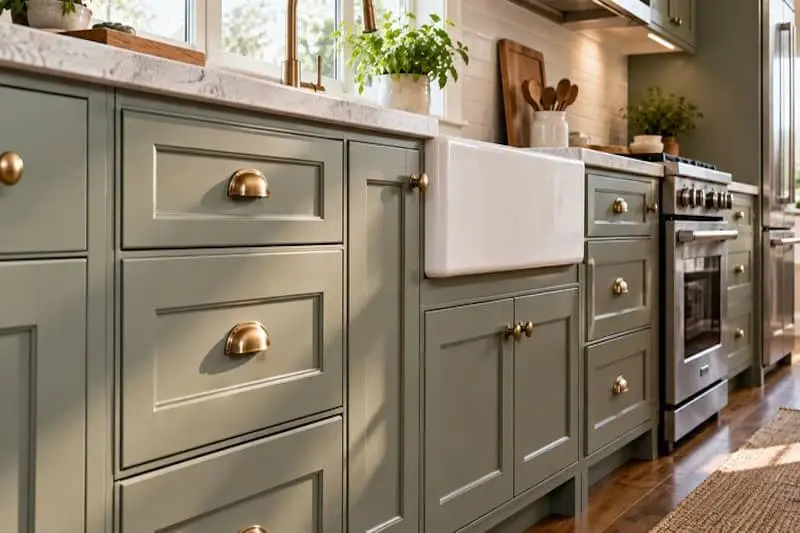
The first place most cabinets show wear is around the hardware. Every time someone reaches for a pull or knob, they touch the same small patch of door or drawer. Finger oils, cooking residue, and the repeated contact break down the finish over time. On cabinets painted with standard interior wall paint, that breakdown often starts within a year or two of regular use.
The damage usually shows up first as a subtle dulling around the pull. Then, it progresses to discoloration and chipping at the edges of the drilled hole. If the cabinet isn’t refinished, that spot becomes bare wood where the finish has separated and peeled.
The pattern is even faster and more noticeable when the cabinets were painted without proper surface prep or the right finish type. Standard interior latex paint doesn’t have the hardness to resist the contact and oils that hardware zones deal with constantly.
A harder urethane-based coating, on the other hand, is much better at resisting damage. It cures to a tougher, more abrasion-resistant shell instead of staying “soft” the way latex paint does.
Sink-Base Cabinets and the Area Around the Stove
Sink-base cabinets are among the most vulnerable in any kitchen. They face all kinds of wear:
- Moisture from the sink itself
- Cleaning products used on surrounding surfaces
- Slow humidity accumulation that collects under the countertop and around the plumbing
Even small water drips that go unnoticed, like a slow seep around a supply line fitting, can cause finish breakdown and wood damage over time.
The door below the sink takes the brunt of that exposure. Repeated washing with harsh degreasers or all-purpose sprays can break down the finish even faster, especially when the coating wasn’t designed to handle regular contact with cleaning chemicals.
Cabinets near the stove face a different kind of exposure. Grease and steam settle on nearby surfaces and gradually form a film that dulls the finish and traps discoloration. Removing that buildup becomes increasingly difficult as it builds up, and aggressive cleaning can easily wear down the finish.
In both these areas, the problem isn’t simply that the cabinets get dirty. It’s that the finish has to withstand the conditions involved in keeping them clean.
Drawer Edges, Lower Corners, and Toe Kicks
Drawer edges take wear from a specific kind of stress: friction. Every time a drawer opens and closes, the painted edge makes contact with the cabinet frame. On a painted cabinet, that repeated friction gradually wears through the finish at the edge where coverage is thinnest to begin with. Sharp transitions are harder to coat thoroughly, and they’re usually the first to show through to bare wood.
Lower cabinet corners have similar vulnerability, but the wear comes from a different source. Vacuum cleaners, mop handles, and feet bump into lower corners constantly. These are low-level impacts, but they build up as the years pass. Not only is the coverage thinner on these corners, but they can’t absorb impact the way a flat panel surface can.
Toe kicks (the recessed panels that run along the base of a cabinet run) face the most direct contact of any cabinet surface. They take foot and shoe contact, get hit by vacuum attachments, and absorb moisture and cleaning solutions from floor washing on a regular basis. Many painted toe kicks begin showing wear before any other area, even when the rest of the cabinetry still looks good.
The Finish Determines How Long Cabinets Hold Up
All these wear patterns point to a larger issue: cabinet paint isn’t just decorative. It also has to function as a protective surface. The areas that show damage first are the ones that face the most impact from contact, moisture, grease, friction, or cleaning.
Many painted cabinets use products that were never designed for those conditions. Standard interior wall paint may look fine when it’s first applied, but it doesn’t have the hardness needed for constant handling and cleaning. Proper cabinet refinishing needs to address that problem through a detailed process:
- Cleaning
- Surface preparation
- Compatible primer
- A coating designed specifically for cabinet use
A hard urethane coating provides much better resistance to finger oils, moisture, cleaning products, and abrasion than standard interior latex paint.
Application is just as important. Poor adhesion, inadequate prep, or thin coverage creates weak points that are especially likely to fail in the highest-stress zones. Experienced kitchen cabinet painting contractors can account for those conditions during preparation and application. They don’t treat cabinets like walls because they know what cabinets face and how to help them hold up.
You can’t make your cabinets impervious to wear, but you can give them a finish to help them last. When experienced painting contractors properly bond and apply that coating, the areas that naturally take the most abuse are far less likely to become the starting point for a larger paint failure.
Protecting Your Cabinets Over Time
Finish quality and proper application do most of the work, but cleaning habits also play a role.
- Don’t use harsh degreasers and abrasive pads. They break down even durable finishes with repeated use.
- Gentle dish soap and a soft cloth are all that’s needed to clean most kitchen residue without stressing the surface.
- Wiping down handle areas and lower doors regularly prevents grease and oil from building up and bonding with the finish over time.
For cabinets already showing wear at the common stress points, those areas don’t improve on their own. And spot painting over chipped or peeling sections almost never produces a lasting result because the underlying adhesion issue hasn’t been addressed.
A proper refinishing project strips the surface back, applies the right prep and primer, and uses a hard finish designed for cabinet use. That’s what produces a result that actually holds up over time. If your kitchen cabinets are ready for refinishing, reach out to Gilded Painting today.
Video